


How to Build a Founder Maternity Leave Plan
A founder maternity leave plan that keeps your startup running: what to delegate, when to start, what it costs, and how to get to zero unplanned calls.

Two months before her due date, a founder I advise told me what worried her most about her maternity leave. Her team had a revenue goal the board was counting on, and she wasn't sure they would hit it without her. Underneath that were two bigger questions. Would the company keep running while she was gone? And could she spend uninterrupted time on her most important new job: learning how to be a mother and nurturing a new human?
She was a first-time mom running a high-growth, venture-backed tech startup. I was her strategic advisor. We had been meeting weekly for about a year on revenue growth, leadership, and team management, so when she told me she was pregnant, we started building her leave plan together.
A founder maternity leave plan hands every decision you own to a named person with written limits, pauses only what can wait, and sets a communication rhythm so your team never needs to call you unplanned. Start two to three months before your due date, treat the week before your due date as day one, and budget for outside support anywhere you don't have a leader in place. Want a head start? Get my free founder maternity leave plan template.
I measure a plan's success by one standard: zero unplanned contact. Everything that reaches the founder should be planned, episodic, and asynchronous. Our plan got close. She was contacted outside the plan about three times in two months, and by the time you finish this post, you'll know the two missing pieces that would have taken that number to zero.
You'll also see what I caught by running her team meetings that never came up in our 1:1s and wouldn't have shown up in a written update, and why one rule in this playbook defaults to yes when every instinct says it should default to no.
One honest caveat before we start: preparation depends on good hiring. If the company is a dumpster fire before you leave, it will be a dumpster fire when you get back. Hers wasn't. She had hired strong leaders who kept the wheels turning, and the plan gave them what they needed to do it.
What should go in a founder's maternity leave plan?
A good plan lists everything you personally own, gives each item an owner and a limit, and spells out how and when the team communicates with you.
She built the first draft herself, and it was strong. My job was to ask questions several layers deep to find what she hadn't considered, and to add the issues I know come up when a leader goes out. Here's an example of what "several layers deep" means:
- If there's a commission dispute, who is authorized to handle it?
- What decision-making responsibility do you want me to have?
- Is there a dollar amount that requires escalating it to you, or can I decide anything under $5,000?
That last question is the one most plans skip. "Sales manager handles commission questions" sounds complete until the first dispute lands and nobody knows how far their authority goes.
Your plan should include:
- Rough dates: your leave window and your return schedule. She planned to come back four days a week for the first stretch.
- An inventory of everything you own, sorted by function: finance, people, investors, sales, operations, product, and team rhythms. Each item gets one of three labels: hand off, pause, or keep.
- One owner for every item. Not "the sales manager or another rep." The quickest way to kill a plant is to put two people in charge of watering it.
- Owners and attendees for every recurring meeting, so the revenue review, product meeting, and team meetings keep running.
- The forgettable admin: who opens the mail, deposits checks, and signs NDAs and contracts.
- A call list: the specific situations that justify contacting you, with dollar thresholds.
- A communication plan: who sends you what, on what day, in what format.
- Emergency contacts, including your spouse or partner, a board member, and your company's lawyer.
- A return plan, written before you leave. More on that at the end.
When should you start preparing for maternity leave?
Start three months before your due date if your policies and procedures aren't written down, or two months if they are.
We started about two months out. That worked because I had already advised her for a year and she had built SOPs and decision frameworks along the way on her own, so the lift was lighter. For a typical startup founder with little documentation, I'd use three months:
- Months one and two: document. Write down the policies and procedures the team will need. The best source is your own calendar and inbox. Go through your meeting notes and conversations, find the problems and questions that come up most often, and turn each one into a written rule.
- Month three: transition. Move each person to whoever will support them while you're out, through at least one joint meeting with you, the employee, and their new point person.
- Buffer: about a month. Babies don't always come on time.
- Start date: the week before your due date, whether or not the baby has arrived.
- Coverage: about two and a half months of outside support for a typical leave, plus an overlap when you return.
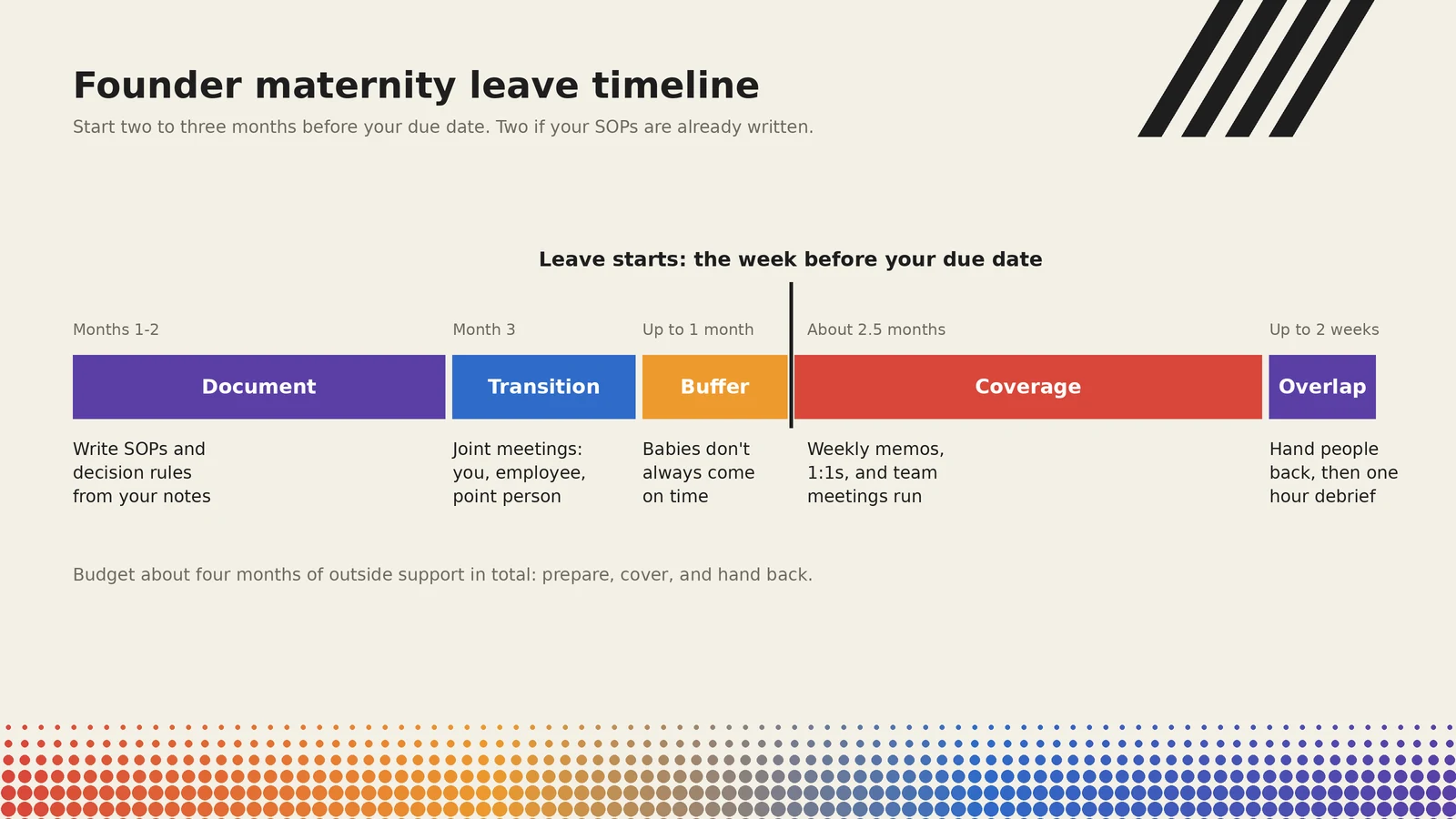
All in, I'd budget about four months of additional advisory support to prepare, cover, and hand back. If you're short on time, put the deal, money, and policy decisions first, then rep handoffs. Those are where things break.
Two more things belong before your last day. Finish next quarter's planning, because a team waiting for your input will wait. And make sure every person knows their goals, the company's goals, and how the two connect. If individual targets, company targets, and comp quotas don't reconcile, someone will notice while you're gone, and it will become a pay question.
Which decisions should you delegate, and which should wait?
Keep anything "below the line," meaning anything that could sink the ship, and delegate everything else with written limits.
Below the line usually means:
- Large financial commitments.
- Key customer issues, especially if your largest customer is unhappy or could become unhappy.
- Investor communications, unless you have a strong co-founder.
- Onerous or unusual legal agreements.
Everything above the line gets delegated with limits. Someone might be able to approve a $2,000 office purchase on their own, with anything over $3,000 coming to you. A clear budget makes these limits easy to set.
Pause anything that needs a lot of your input but isn't critical to running the company, like switching CRMs or rebuilding part of the product that works but needs updating. In my experience, most things founders think should be paused can be delegated.
Then write down every rule that currently lives in your head. This is where most founders get stuck. Every time you make a ruling during your leave, add it to the policy doc so the team never has to ask twice.
A few more rules make delegation work:
- Define "act or ask" for your leaders. One of her leaders knew she was supposed to make a call but didn't feel comfortable doing it. The fix: have the employee post their plan with a date, and tell them to proceed unless someone objects.
- Pre-decide the month-end and quarter-end questions. Can the team make special deals at the end of a quarter? If so, what are the limits? The same goes for payment terms, shipping exceptions, and other risk calls that tend to land in the last two weeks, when they're hardest to decide well.
- Set a default for decisions you don't answer. If a decision commits money or can't easily be undone, the default is no unless you say otherwise within a set time. I told one rep, "It's a no for now unless I hear otherwise," and the customer got a clear answer instead of a slow one. Some decisions should default to yes, though, and I'll show you which ones in the product section.
When should your team contact you during maternity leave?
Only for the specific situations on your call list, plus anything big enough to change the company.
Her call list was short and specific:
- No new hires without an interview with her.
- Anyone leaving the company.
- Legal issues or lawsuits.
- Wire transfers over a set amount.
- A major customer issue: a large quality problem, a dispute with a key account, a large refused order, or a contract with unusual payment terms.
Two additions make a call list stronger. First, add opportunity triggers, not just problems. "Call me if a deal could change the company" makes sure big upside doesn't get buried in a weekly update. She caught one of these herself, which is exactly how it should work.
Second, batch everything else. Non-urgent decisions go on a weekly decisions list, and she answers within a week. If she doesn't, the default applies.
So why was she contacted three times? Mostly for end-of-quarter deal approvals and to brief her on a goals issue that had become a morale problem. That second one didn't match any trigger on her list, and it still became the biggest people issue of the leave. The two missing pieces were a month-end and quarter-end playbook for getting deals done, and clear goals communicated to every person before she left. With both in place, I believe unplanned contact goes to zero.
How do you stay informed without getting pulled back in?
Get short written updates on a fixed day, and read them on your schedule.
Her plan asked each leader for a weekly memo every Wednesday: one page in a Google Doc so she could comment, sent with "Memo" in the subject line. The format:
- TL;DR: one sentence with a green, yellow, or red status and why.
- This week: two to four bullets on what happened or shipped.
- Numbers: the two or three metrics that matter for that function, against target.
- Risks and blockers: anything trending the wrong way, even if it isn't urgent yet.
- Needs you: anything on the call list or any decision only you can make. If none, say "none."
- Next week: what's planned.
The sales version swaps in a pipeline snapshot, top deals, stalled deals, and lost deals with the reason.
As her strategic advisor, I sent her a separate weekly brief, rolled up from every meeting and 1:1 I attended plus any one-off Slack threads. It covered status, issues, and communication, and it ended with a short list of decisions only she could make. I wrote mine without reading the team's memos. Reading theirs first would have let me filter, but writing independently meant she got a second view without any bias from theirs.
One more tool I'd use next time: an AI project for the founder and another for the advisor, connected to documents, Slack, email, meeting recordings, and the weekly memos. The founder's version summarizes what's worth her attention. The advisor's version checks issues against the written policies, suggests guidance, and helps draft the weekly brief. It keeps everyone informed and keeps coverage hours down.
Why should someone run your meetings instead of just reading memos?
Because the problems that slow a team down show up in the room, not in the write-up.
I ran her weekly sales meeting and held 1:1s with reps, and I noticed things no memo would have told her. We run a standard L10 format, where issues get listed and prioritized before anyone discusses them. Early on, some team members would launch into long side quests about things that weren't on the list. I stepped in several times to remind everyone how the meeting works: hold it until it's prioritized.
I helped one person give shorter, clearer status updates. I also called out tension when I saw it, then dug in during 1:1s. One rep felt he was carrying the team, and other reps had started bringing him their problems. The pressure made him anxious and quicker to get frustrated, and some of that frustration landed on leadership. Once we found the root cause, I helped him reset how he was looking at it, and we fixed the structural problems underneath.
Goals got sharper too. A sprint goal like "inform customers of the new feature" has no teeth. "Inform five customers of the new feature and get three of them using it successfully" does. We practiced writing goals so that done meant done well.
The result: meetings got more efficient, more got decided, and more to-dos got finished. None of that would have appeared in a memo, and all of it affected performance. If you want a structure for those 1:1s, here's the format I use.
Who covers for you if you don't have a leader in place?
An experienced outside leader for each missing function, working from your written SOPs and decision frameworks.
In her case, the coverage split cleanly. Her co-founder covered product, a senior employee covered operations, and I covered sales as an advisor, with a consultant from my team meeting with two of the reps. We weren't responsible for the number. We helped the team hold itself accountable to hitting it. All of them were highly capable, and the company kept running smoothly.
If you don't have people to delegate to, you need someone who can step in, either a consultant who has been a founder or an advisor for each function. I keep a bench of senior executives across operations, finance, sales, and marketing who know how to get their hands dirty for exactly this reason. Whoever steps in should work from the same SOPs and decision frameworks, and own that function's 1:1s, team meetings, and priorities.
Sales
Weekly 1:1s with each rep, the weekly sales meeting, and the pipeline review. The person covering doesn't own the number. They keep the activity going, because the right activity leads to revenue.
Product
The backlog, sprint planning, and the product meeting, run against the priorities you set before you left.
Operations
Ops reviews, fulfillment, and the escalation paths for quality and customer issues.
How do you keep sales momentum going while you're out?
Review every deal every week, protect lead generation, and focus the last two weeks of each period on what's closest to the money.
One of her biggest concerns was missing the board's revenue goal, so most of our prep went into what each rep needed to be coached on and held accountable to. In every 1:1, we reviewed the pipeline deal by deal and set a next step for each one. We tracked progress against lead goals every week and brought a marketing stakeholder into the sales meeting so lead volume and strategy were always part of the conversation. As long as leads and prospecting continue, revenue becomes less of a problem.
About three weeks into her leave, the quarter was at risk. For the last two weeks, we ran deal war rooms. Every sales meeting focused only on what had to happen to get revenue in: which policies we could flex, invoicing exceptions, shipping strategy. The operations lead and her co-founder joined so decisions could be made in the room. "What's closest to the money?" is one of my favorite questions, and it was the only one that mattered those two weeks. The war rooms, plus a few well-timed deals, got the quarter back on track.
Early-stage revenue has some luck in it. Remember: the harder you work, the luckier you get.
How should your team handle customer issues and exceptions?
Handle most issues by policy and a phone call, and escalate only by deal size or customer importance.
Most customer issues get solved by the rep following the policy and making a few calls. If it was a one-off and it's fixed, let it sit. Escalate when:
- The deal is unusually large. Set the threshold from your average deal size. If a deal is at risk and is one or two standard deviations above average, it goes to the founder. Everything else gets handled internally.
- The customer is unusually important. During her leave, a very large customer was embarrassed in front of their own customer by an obvious pricing error. Most of the fault wasn't my client’s, but because the account was so large, I'd want the founder to call, commiserate, and ask if there was anything they could do to help. It also showed us a product safeguard to build: flag any number far outside the normal range before it goes out.
Urgent questions that could derail a large deal need fast answers. For everything else, a clear no beats a slow maybe.
How should product prioritization run without you?
Build enough backlog to last the whole leave, tie every item to an outcome, and let the team ship without waiting for you.
Before you leave:
- Make sure the backlog covers the entire leave.
- Give every feature a defined outcome or metric it should move.
- Research the outcome first, with customer or teammate feedback.
- If it passes those gates, release it.
She built and prioritized a strong backlog, but some features still sat waiting for her sign-off, possibly because the team was still adjusting to her being out. This is where defaults matter. Decisions that are easy to reverse, like shipping a feature or moving something up the backlog, should default to yes. The product team includes them in the memo, and they move forward unless the founder says no within a week. Decisions that commit money or can't be undone default to no.
When new issues come up, place them in the backlog by their quantified impact on customers, so low-impact features don't jump ahead of high-priority ones. And when revenue and the customer pull in different directions, tie goes to the customer. It's the better long-term business.
How do you handle hiring, firing, and team changes during maternity leave?
Hiring can continue within limits you set ahead of time, firing always comes to you, and most other team changes can wait.
Hiring. Many founders want the final interview, which is fine. If your team is strong enough to hire without you, agree on comp, the job description, hiring criteria, and negotiation limits before you go. For example, the hiring manager can offer up to $10,000 more in annual salary, or has up to $10,000 in signing bonuses to use.
Firing. Always escalate. It can become a legal issue.
Promotions, schedule changes, and transfers. Pause them. Two months is a reasonable wait. The exception is someone who needs to reduce their hours: treat that as an inform, put a temporary solution in place, and decide the long-term plan when you return.
Resignations. You should always know if someone is trying to quit. If they're in good standing, their manager should ask what, if anything, would keep them, and call you for approval if the ask is reasonable.
When someone does leave, reassign their accounts right away and treat every inherited account as a fresh first conversation. In one company, a rep left shortly before the leave, and a positive reply from a prospect sat unanswered for nine days in the handoff. The rep who started treating inherited accounts as new conversations got answers his predecessor never did.
What documentation should your team have before you go?
A short list of must-haves, plus a few nice-to-haves if you have time.
Must-haves:
- Your maternity leave plan, shared with the team, including the return plan.
- Emergency contact information.
- Sales rules of engagement: who owns which leads, what reps can approve, and month-end and quarter-end deal limits.
- Commission calculators for the sales team.
- Operations SOPs for customer fulfillment, including end-of-period exceptions.
- Escalation rules and plans.
- A signing and payments authority list: who can sign contracts and NDAs, and approve wires and invoices, up to what amount.
- Approved budgets and spending limits.
- Company goals for at least the next three months, and goals and priorities for each person.
- A scorecard or dashboard with the most important company metrics, with someone assigned to update it.
- Active pipelines for sales (ideally in the CRM), fulfillment, contracts, and employee commitments. That includes promises like a raise someone was guaranteed during your leave.
- A key account list: top customers, who owns each relationship, and their current health.
- A calendar of deadlines that can't slide: renewals, payroll, taxes, insurance, board meetings.
- The product backlog.
- Owners and attendees for every recurring meeting.
- A checklist of the documents your internal or outside support needs access to.
Nice-to-haves:
- Memo templates.
- A team time-off and events calendar across your leave.
- A decisions log.
- Setup tasks: a shared password manager with delegated access, email accounts and system access for outside support, and calendar invites to recurring meetings.
How do you prepare your board, investors, and key customers?
Tell your board early and walk them through the plan, and tell everyone else only as much as their role requires.
- Board: Start the conversation as soon as you're ready to share the pregnancy, usually after the first trimester, so they can help you prepare. Walk them through the plan and procedures, introduce them to the key players, and set expectations on updates. The board shouldn't expect updates during your leave unless you've decided otherwise ahead of time. Prepare messaging on goals, too, so you can set expectations with the board and line up an encouraging note for the team.
- Investors: Investors who aren't on the board only need a heads-up a few months ahead, if you feel it's necessary. Strategic investors should know which accounts or strategies may need their help while you're out. If you send regular investor updates, say whether and when they'll continue. Share the plan if it makes sense.
- Strategic partners: Bring them in three months ahead and build their part of the plan with them: what's reasonable to escalate and who their point person is.
- Customers and other partners: Tell them only if they work with you directly, and give them a point person.
- Arrival notice: Have family or friends let everyone know when the baby arrives and the plan officially starts.
Before you leave, also align your budget with your investors. Ask for more than you think you'll need.
How much should you budget for maternity leave coverage?
Plan on a monthly retainer for two to three months of coverage, priced by meeting, plus a one-time documentation cost if your SOPs don't exist yet.
These are the budget guides I give founders for outside support, once leave starts:
| Coverage | Budget guide | Notes |
|---|---|---|
| Exec 1:1 (managers and above) | $750 per person, per meeting | Weekly. One exec is about $3,000 a month. |
| Leadership team meeting | $1,000 per meeting | Weekly. |
| Individual contributor 1:1 | $400 per person, per meeting | Weekly. Lower-cost support for junior team members. |
| Individual contributor team meetings (for example, pipeline) | $750 per meeting | Weekly. |
| Founder meetings | $750 per meeting | About four the month before leave and two the month you return. |
| Documentation and SOPs | About $15,000, one time | Only if they aren't already in place. |
| Performance bonus | $2,000 to $5,000 a month | Paid if key goals are hit. |
I'd structure it as a monthly retainer, paid at the start of each month, for two to three months depending on how long you'll be out. "Execs" means managers and above. Covering junior employees with lower-cost support saves money. If your SOPs are already documented, your team can work through the checklist above and skip the documentation cost.
A worked example: a three-month leave with weekly 1:1s for four execs and a weekly leadership meeting. That's $16,000 a month, or $48,000 for the leave. Add $15,000 to build the documentation, $4,500 for six meetings with you before and after, and a $6,000 to $15,000 performance bonus, and the total is about $73,500 to $82,500.
Now compare. Covering ten reps with weekly 1:1s and a weekly pipeline meeting runs about $19,000 a month, a little more than a $200,000 full-time manager at about $16,700 a month. But it's two or three months instead of a permanent hire, with no recruiting time, no severance risk, and more senior people than most managers. The fairer comparison is a full-time CRO, who typically costs $250,000 to $500,000 a year (about $21,000 to $42,000 a month), takes months to find, and keeps the seat after you're back. For a few months, outside support gets you senior talent while you're out.
What should your return plan include?
Keep it simple: decide the overlap, hand people back, and hold one debrief.
- Overlap: decide before you leave whether you want overlap on team meetings and 1:1s. Two weeks at most.
- Handoff: hand each person back to you or their manager in a joint meeting.
- Phase back in by joining meetings and 1:1s until your outside support rolls off. She planned to come back four days a week and pick up some deals herself.
- A one-hour debrief on your first days back: key findings, adjustments, people updates, product needs, and every open decision.
After the overlap, step down to a regular rhythm, like a weekly meeting between you and your advisor.
What should you do first if you're due in four months?
Decide which functions need leadership, choose the SOPs that matter most, estimate the cost, align the budget with your investors, and line up your support.
In order:
- Decide which functions need leadership coverage while you're out.
- Figure out which SOPs are most important to create first.
- Estimate the expenses you’ll need to account for to support your leave.
- Meet with your investors to make sure the budget is aligned, and ask for more than you expect to need.
- Bring in the people who will help you build the plan and staff it.
In my next post, I'll walk through what happened during the leave itself: what broke, what surprised us, and what I'd change.
Frequently asked questions
Who covers sales if I don't have a sales leader?
Bring in an experienced outside sales leader, ideally someone who has been a founder, to run weekly 1:1s with each rep, the sales meeting, and the pipeline review. They don't own the number. They keep the activity going and help the team hold itself accountable, working from your written rules of engagement and approval limits.
How reachable should I be during maternity leave?
Aim for zero unplanned contact. Read weekly written updates on your own schedule, attend only the meetings you planned in advance, like a goal-setting session, and take calls only for the situations on your call list.
Can my co-founder cover for me?
Yes, if they're capable. A strong co-founder can take on more of what would otherwise stay with you, including investor communications. Write down what they own and their limits, just as you would for anyone else.
What happens if a key employee quits while I'm on leave?
You should always know when someone is trying to leave. If the person is in good standing, their manager asks what would keep them and calls you for approval if the ask is reasonable. If they go, reassign their accounts the same day and have the new owner treat each one as a fresh conversation.
When should I tell my board and investors about my maternity leave?
Tell your board as soon as you're comfortable sharing the pregnancy, usually after the first trimester, and walk them through your plan. Give other investors a heads-up a few months ahead if you feel it’s necessary, and tell them whether your regular updates will continue.
Do I need outside help, or can my team handle it?
If your SOPs and decision rules are already written down and you have a strong leader for each function, your team can work from a checklist on its own. Bring in outside support for any function without a leader and for building documentation you don't have yet.
Get the Founder Maternity Leave Plan template
Use the same structure I use with founders: the ownership inventory, decision limits, call list, memo format, contact sheet, and return plan, ready to fill in. Make a copy of the template.
Want help building yours? Book a time to talk.
About the author
Chris Leithe is the founder of Leithe Labs and a strategic advisor to founders, high-growth CEOs, and medical device distributors. The medical distributors he advises are responsible for almost $200MM in revenue, and several are in the top 10 for their manufacturers. Before that, he helped scale ShareFile's sales team from 30 to 300, helped grow Adwerx from $10MM to $27MM in revenue, and built the sales process for an SF-based healthcare tech company that sold to PE for $200MM. Chris advises tech companies, services companies, and medical distributors on revenue growth, leadership, and hiring.

Chris Leithe
Founder and Strategic Advisor, Leithe Labs. Growing revenue and leaders for 15 years.


Related articles


Sign up for our newsletter.
You’ll only be emailed 1x a week and can unsubscribe at any time.

Sign up for business insights and sales hacks:
You’ll only be emailed 1x a week and can unsubscribe at any time.


Copyright © Christopher G Leithe, 2026 All Rights Reserved • Site Design by Haley Ahokas
Copyright © Christopher G Leithe, 2026 All Rights Reserved
Site Design by Haley Ahokas
